5 Best Smart Scales in Australia for 2026
Compare 5 smart scales available in Australia — body composition, connectivity, capacity, features and who each model suits.
Last updated: September 2026
A smart scale is a connected bathroom scale that measures your weight and, in most cases, estimates additional body-composition metrics such as body-fat percentage, muscle mass and visceral fat, then syncs the results to a smartphone app so you can track changes over time. They suit people who want an easier way to log weight trends automatically, keep a household's readings organised by profile, or connect that data into a broader fitness ecosystem such as Apple Health, Google Fit or Garmin Connect.
It's worth setting expectations before you buy: weight is the one figure a smart scale measures directly. Everything else — body fat, muscle mass, bone mass, water percentage and similar metrics — is an estimate calculated using bioelectrical impedance analysis (BIA), and those estimates can shift from day to day based on hydration, food, exercise and even how you're standing on the electrodes. They're genuinely useful for spotting a trend over weeks or months under reasonably consistent conditions, but they're not a substitute for clinical body-composition testing.
This guide compares five smart scales currently listed on Amazon Australia — from a budget entry-level option to an eight-electrode segmental-tracking model — based on their listed specifications, connectivity, ecosystem fit and available customer feedback, so you can match a model to your household, budget and the app ecosystem you already use.
Quick Picks
Comparison Table
| Product | Best For | Connectivity | Body Composition | Max Weight | User Profiles | Standout Feature | Amazon |
|---|---|---|---|---|---|---|---|
| RENPHO Elis 1 | Budget entry-level tracking | Bluetooth | 13 measurements (app) | 180 kg (listed) | Unlimited (app) | Apple Health / Fitbit / Samsung Health listed sync | Check price |
| Xiaomi S400 | Feature count for the price | Bluetooth Low Energy 5.0 (verify AU app compatibility) | 25 listed indicators, resting heart rate | 150 kg (listed) | Up to 36 (listed) | Dual-frequency BIA + heart-rate reading | Check price |
| RENPHO MorphoScan Base | Segmental body-composition tracking | Bluetooth | 8-electrode hand+foot, dual-frequency BIA | 180 kg (listed) | Up to 8 on-device / unlimited (app) | Segmental analysis (arms, legs, trunk) | Check price |
| Withings Body Smart | Comprehensive everyday tracking | Wi-Fi + Bluetooth | Multi-frequency BIA, 4 sensors, position detection | ~200 kg (listed) | Not stated in listing reviewed | Pregnancy / baby / athlete / pacer modes | Check price |
| Garmin Index S2 | Existing Garmin Connect users | Wi-Fi | BMI, body fat, skeletal muscle, bone mass, water % | ~181 kg (listed) | Up to 16 (listed) | Direct Garmin Connect sync | Check price |
Prices change frequently on Amazon and are not shown here — use the "Check price" links above for current pricing, stock and shipping information.
Which Smart Scale Should You Choose?
The five scales in this guide serve genuinely different buyers rather than competing head-to-head on the same job, so we haven't picked one universal "best overall" — the evidence doesn't support a single winner across such different price points and use cases. Instead, here's a concise recommendation by buyer type:
How We Chose
Research snapshot
| Research date: | September 2026 |
| Market checked: | Australia / Amazon Australia |
| Products compared: | 5 |
| Hands-on testing: | No |
| Selection basis: | listed specifications, body-composition capabilities, connectivity, ecosystem compatibility, Australian availability, customer feedback, ease of use, family/multi-user support and relative value |
MegaCalcOnline has not physically tested any of the smart scales in this guide. Each product was compared using the information available on its current Amazon Australia listing and, where available, the pattern of customer feedback attached to that listing. Customer ratings and review counts can change after publication, and are treated as supporting evidence rather than independent product testing — see the individual reviews below for model-specific caveats, including a review-aggregation issue we identified with the RENPHO MorphoScan Base listing.
A note on limitations: listing specifications can be updated by manufacturers and sellers over time, customer feedback reflects the experience of the people who chose to leave a review rather than every buyer, and we could not independently verify every claim made in a product listing. Where a specification wasn't clearly stated in the information we reviewed, we've said so directly rather than guessing.
How Smart Scales Estimate Body Composition
Most consumer smart scales use a technique called bioelectrical impedance analysis (BIA). When you stand on the scale, a very small, imperceptible electrical current travels through your body between the metal electrodes on the platform (and, on eight-electrode models like the RENPHO MorphoScan Base, through a handle you hold as well). Because fat, muscle and water conduct electricity differently, the scale measures how quickly that current travels and combines it with details you've entered — age, height, sex and sometimes activity level — to estimate your body composition using a built-in algorithm.
This means body-composition readings can shift noticeably based on factors that have nothing to do with a real change in your body: how hydrated you are, whether you've recently eaten or exercised, the time of day, how dry or damp your feet are, and even exactly where your feet land on the electrodes. None of this makes the scale "wrong" — it's simply the nature of how BIA estimates work.
The practical takeaway is to treat any single body-composition reading as a rough estimate, and instead focus on the overall trend across weeks or months when you weigh in under reasonably similar conditions — for example, first thing in the morning before eating or drinking. A trend line is far more informative than any one number on its own.
Individual Reviews
RENPHO Elis 1 Smart Body Scale
Best BudgetQuick verdict: a well-established, inexpensive entry point into app-based weight and body-composition trend tracking, with strong ecosystem compatibility for the price.
Best for: buyers who want simple, affordable weight and body-composition trend tracking without paying for advanced features.
| Model | ES-CS20M |
|---|---|
| Measurements | 13 body measurements per the listing; weight, BMI and body-fat percentage shown on the scale, additional metrics stored in the RENPHO Health app |
| Connectivity | Bluetooth; listing states compatibility with Samsung Health, Fitbit and Apple Health (Apple Watch support listed except Series 1) |
| Electrodes | Four |
| Capacity | 180 kg / 400 lb (listed), 0.05 kg / 0.2 lb increments |
| Profiles | Unlimited user profiles in-app per the listing; baby/pet weighing mode included |
| Build | Glass construction, AAA batteries, approximately 1.25 kg |
| Research-time price (Sept 2026) | Approximately A$34.99 — not necessarily current, check the listing |
Why it stands out: At the time of our research, the Elis 1's Amazon Australia listing showed approximately 4.6 out of 5 from around 330,923 global ratings — a large and well-established listing history for this price bracket. Available customer feedback commonly praised its ease of use, value and app connectivity; feedback specifically about body-composition accuracy was not universally positive, consistent with the general BIA limitations discussed above.
Potential advantages
- Low price relative to feature set
- Large, established review history
- Unlimited app profiles and a baby/pet mode
- Broad listed app compatibility (Apple Health, Fitbit, Samsung Health)
Potential drawbacks
- Only weight, BMI and body fat shown on the scale itself — other metrics are app-only
- Body-composition accuracy feedback was mixed, not universally positive
- Four-electrode design only — no segmental (arms/legs) breakdown
Choose this if… you mainly want an affordable way to track weight and general body-composition trends in an app, without needing segmental data or premium extras.
Skip this if… you specifically want segmental body-composition tracking or a scale with on-device Wi-Fi syncing — consider the RENPHO MorphoScan Base or Withings Body Smart instead.
Xiaomi Body Composition Scale S400
Best Value for FeaturesQuick verdict: a long feature list for the price, including resting heart-rate measurement — but Australian buyers should verify Mi Home app compatibility before purchasing.
Best for: buyers who want a longer list of body-composition indicators and a resting heart-rate reading at a mid-range price, and who are comfortable checking app compatibility before buying.
| Model / Part | BHR7793EU / BHR7793GL |
|---|---|
| Body composition | Dual-frequency BIA; 25 health/body-composition indicators per the listing, including BMI, visceral-fat level, BMR and muscle-related measurements |
| Additional metric | Static/resting heart-rate measurement |
| Connectivity | Bluetooth Low Energy 5.0; Mi Home app — see Australian compatibility warning above |
| Capacity | 150 kg (listed), 0.1 kg / 100 g minimum division |
| Profiles | Up to 36 user profiles per the listing |
| Build | Reinforced glass + engineering plastic, approximately 300 × 300 × 24.55 mm, approximately 1.45 kg, three AAA batteries, up to approximately 180 days battery life depending on use per the listing |
| Research-time price (Sept 2026) | Approximately A$45.50 — not necessarily current, check the listing |
Why it stands out: At the time of our research, the listing showed approximately 4.4 out of 5 from 2,701 global ratings, with 74% five-star at research time. Some Australian users praised the slim design, display and value in available feedback. Its 25 listed indicators and resting heart-rate measurement give it a longer feature list than the RENPHO Elis 1 at a modest price increase — the main caveat is the Australian app-compatibility issue detailed above, which is a significant consideration before buying.
Potential advantages
- Long list of listed body-composition indicators (25)
- Resting heart-rate measurement, uncommon at this price
- Slim design praised in available feedback
- Supports up to 36 profiles per the listing
Potential drawbacks
- Reported Mi Home app connectivity issues for some Australian purchasers — verify before buying
- Lower maximum capacity (150 kg) than most other models in this guide
- Fewer global ratings than the RENPHO Elis 1 at research time
Choose this if… the feature list and price appeal to you and you're willing to verify seller/region app compatibility before or immediately after purchase.
Skip this if… guaranteed, hassle-free app connectivity out of the box matters more to you than the extra features — the RENPHO Elis 1 or Garmin Index S2 have less-reported regional friction.
RENPHO MorphoScan Base
Best Advanced Body CompositionQuick verdict: the only 8-electrode, segmental-tracking scale in this comparison, positioned for buyers who want arm/leg/trunk breakdowns rather than a single whole-body estimate.
Best for: buyers who specifically want segmental body-composition data and are comfortable paying more for it.
| Model | R-MSC02 |
|---|---|
| Electrodes | Eight-electrode design — hand and foot electrodes, dual-frequency BIA per the listing |
| Analysis type | Segmental body-composition analysis (per limb/trunk) plus body fat, BMI, muscle-related metrics and visceral-fat index |
| Display | Seven-day weight trend shown on the scale; additional metrics in the RENPHO Health app |
| Capacity | Approximately 180 kg / 400 lb |
| Profiles | Up to eight profiles supported on the display per the listing; unlimited in-app |
| Connectivity | RENPHO Health app; listing references Apple Health, MyFitnessPal and Samsung Health syncing |
| Build | Approximately 2 kg, large platform with handle, approximately 60-inch handle cable per the listing |
| Research-time price (Sept 2026) | Approximately A$178.21 — not necessarily current, check the listing |
Why it stands out: Every other scale in this guide uses a four-electrode, feet-only design and produces a single whole-body estimate. The MorphoScan Base's eight-electrode hand-and-foot design is intended to let the scale estimate body composition separately for your arms, legs and trunk rather than just one overall number — useful if you specifically want to track how composition differs across your body, such as during a structured strength-training programme.
Potential advantages
- Only segmental-tracking model in this comparison
- Seven-day trend shown directly on the scale
- Large platform and handle for stability during measurement
- Broad listed app-sync compatibility
Potential drawbacks
- Highest price point among the RENPHO/Xiaomi options in this guide
- Larger and bulkier than a simple platform-only scale, due to the handle
- Review evidence specific to this exact model couldn't be clearly isolated (see note above)
- Segmental data is still BIA-based, not clinically diagnostic
Choose this if… segmental body-composition tracking is specifically what you're after, and you're comfortable paying more than the simpler options in this guide.
Skip this if… you just want overall weight and general body-fat trend tracking — the RENPHO Elis 1 covers that at a fraction of the price.
Withings Body Smart
Best Premium Everyday ScaleQuick verdict: the most comprehensive everyday feature set in this guide — Wi-Fi and Bluetooth, multiple lifestyle modes, and a 2-year warranty — at the highest price alongside the Garmin Index S2.
Best for: buyers who want a premium, connected-health scale with broad mode support (pregnancy, athlete, baby) and don't mind paying more for it.
| Connectivity | Wi-Fi and Bluetooth; Apple Health / Google Fit compatibility per the listing |
|---|---|
| Measurements | Weight, BMI, body fat, muscle mass, bone mass, water, visceral fat, lean mass, resting/standing heart rate — multi-frequency BIA |
| Hardware | Four weight sensors, body-position detection, listed 50 g weight increments |
| Modes | Pregnancy mode, baby mode, athlete mode, pacer mode, eyes-closed mode |
| Capacity | Approximately 200 kg (listed) |
| Battery / warranty | Approximately 15 months battery life per comparison information; 2-year manufacturer warranty |
| Research-time price (Sept 2026) | Approximately A$197 — not necessarily current, check the listing |
Why it stands out: At the time of our research the listing showed approximately 4.3 out of 5 from 182 global ratings. Australian reviewers in available feedback praised its appearance, ease of use, automatic user recognition and Apple Health syncing. We're not hiding the less favourable feedback here: reports on accuracy, reliability, software and value were mixed, and at least one Australian reviewer reported incorrect readings after a period of use along with dissatisfaction with support. Weigh this alongside the positive feedback rather than only the headline feature list.
Potential advantages
- Wi-Fi syncing — no need to open the app manually each time
- Broadest mode set in this guide (pregnancy, baby, athlete, pacer, eyes-closed)
- Automatic user recognition praised in available feedback
- 2-year manufacturer warranty, longer than most competitors
Potential drawbacks
- Highest price point in this comparison alongside the Garmin Index S2
- Mixed feedback on long-term accuracy and reliability
- At least one reported case of degraded readings and support dissatisfaction
- Smallest global rating sample (182) of the five models at research time
Choose this if… you want the broadest everyday feature set — pregnancy/athlete/baby modes and Wi-Fi convenience — and are comfortable with the mixed long-term feedback.
Skip this if… you're already committed to the Garmin ecosystem, or the mixed reliability feedback is a dealbreaker for you — the Garmin Index S2 or RENPHO Elis 1 may suit better.
Garmin Index S2
Best for Garmin UsersQuick verdict: the strongest reason to choose this model is direct Garmin Connect integration, not a higher price implying better accuracy.
Best for: buyers already using Garmin Connect for training who want weigh-ins to appear alongside their existing activity data automatically.
| Model | 010-02294-13 |
|---|---|
| Measurements | Weight, weight trend, BMI, body-fat percentage, skeletal muscle mass, bone mass, body-water percentage |
| Connectivity | Wi-Fi syncing direct to Garmin Connect |
| Display | High-resolution colour display; weight-only option available; weather widget |
| Profiles | Up to 16 user profiles; supports multiple daily weigh-ins |
| Capacity | Approximately 400 lb / 181 kg |
| Battery / warranty | Up to approximately 9 months on four AAA batteries; 12-month warranty; approximately 1.99 kg |
| Research-time price (Sept 2026) | Approximately A$207 — not necessarily current, check the listing |
Why it stands out: At the time of our research the listing showed approximately 4.3 out of 5 from approximately 3,234 global ratings. Customers particularly valued the direct Garmin Connect integration in available feedback, and Australian feedback included positive reports about Wi-Fi syncing and automatic logging. Feedback on body-composition accuracy and overall value was mixed, similar to the other models in this guide — the case for choosing this scale is ecosystem fit rather than an assumption that it's inherently more accurate because it costs more.
Potential advantages
- Seamless, direct sync into Garmin Connect
- High-resolution colour display with a weight-only option
- Supports up to 16 profiles and multiple daily weigh-ins
- Large global rating sample (~3,234) at research time
Potential drawbacks
- Highest price point in this comparison alongside the Withings Body Smart
- Mixed feedback on body-composition accuracy and value, as with other models
- Main advantage (Garmin ecosystem sync) has no benefit if you don't use Garmin Connect
Choose this if… you already train with Garmin devices and want your weigh-ins integrated automatically into Garmin Connect.
Skip this if… you don't use Garmin Connect — you'd be paying a premium price for an ecosystem benefit you won't use; the Withings Body Smart or RENPHO Elis 1 may be a better fit.
Smart Scale Buying Guide
Weight accuracy vs body-composition estimates
Every scale in this guide should give you a consistent, reliable weight reading — that's a direct measurement and the technology is mature. Body-composition figures are a different story: they're calculated estimates, and their usefulness comes from tracking your own trend over time rather than trusting any single reading as exact. Keep this distinction in mind regardless of which model you choose.
Bluetooth vs Wi-Fi
Bluetooth-only scales (RENPHO Elis 1, Xiaomi S400, RENPHO MorphoScan Base) need your phone's Bluetooth on and the app open or recently active nearby to sync a reading — simple in a single-person household, slightly less convenient if several people are weighing in without their phones handy. Wi-Fi scales (Withings Body Smart, Garmin Index S2) connect to your home network directly and can sync a reading even if your phone isn't nearby, which tends to suit multi-user households better, at the cost of typically needing more setup and often a higher price.
App compatibility and ecosystem fit
Check which app each scale uses before buying, and whether that app connects to the fitness ecosystem you already use. The RENPHO Elis 1 and MorphoScan Base use the RENPHO Health app with listed syncing to Apple Health, MyFitnessPal and Samsung Health; the Xiaomi S400 uses Mi Home (with the Australian compatibility caveat discussed in its review above); the Withings Body Smart uses the Withings app with Apple Health/Google Fit compatibility; and the Garmin Index S2 syncs directly into Garmin Connect. Buying a scale that doesn't fit your existing ecosystem means maintaining a second, disconnected app just for weigh-ins.
BIA and electrodes: four vs eight
Four-electrode scales — the RENPHO Elis 1, Xiaomi S400, Withings Body Smart and Garmin Index S2 in this guide — measure impedance through your feet only and produce a single whole-body body-composition estimate. Eight-electrode scales, like the RENPHO MorphoScan Base, add a handle so the current also passes through your hands and arms, allowing the device to estimate composition separately for each limb and your trunk (segmental analysis). This gives more detailed tracking data, but it's still BIA-based — extra electrodes don't turn a consumer scale into a clinical diagnostic device.
Maximum weight capacity and platform size
Listed capacities in this guide range from 150 kg (Xiaomi S400) up to approximately 200 kg (Withings Body Smart). If you're close to a scale's listed maximum, it's worth choosing a model with more headroom — the Withings Body Smart, Garmin Index S2 or RENPHO Elis 1/MorphoScan Base (all around 180–200 kg) offer more margin than the Xiaomi S400.
Multi-user households
If several people in your household will use the same scale, check the listed profile limit and whether the scale can auto-recognise users. On-device profile limits in this guide range from 8 (MorphoScan Base) to 16 (Garmin Index S2), while app-based profile limits are generally much higher or unlimited. A larger household benefits from either a higher on-device profile count or reliable auto-recognition so people don't have to manually select their profile each time.
Athlete, pregnancy and other special modes
The Withings Body Smart lists the broadest set of special modes in this guide — pregnancy mode, baby mode, athlete mode, pacer mode and eyes-closed mode. These modes generally adjust how the scale calculates or displays certain metrics for specific circumstances; they're a convenience feature rather than a medical function, and none of the scales in this guide should be used as a substitute for guidance from a healthcare professional during pregnancy or any other specific health circumstance.
Battery life
Battery life varies by model and usage pattern: the Xiaomi S400 lists up to approximately 180 days, the Garmin Index S2 lists up to approximately 9 months, and the Withings Body Smart lists approximately 15 months per comparison information. Wi-Fi scales generally draw more power than Bluetooth-only models, which is worth factoring in alongside the convenience trade-off discussed above.
Privacy and data considerations
Smart scales send your weight and body-composition data to a manufacturer's app and, in most cases, to that company's servers. If data privacy is a significant concern for you, it's worth reviewing the specific manufacturer's privacy policy and data-handling practices before buying, since this varies between brands and isn't something we've independently verified for the products in this guide.
Is a premium smart scale worth paying for?
Based on the evidence gathered for this guide, a higher price generally buys you more connectivity options, a broader feature set, or ecosystem integration — it does not reliably buy you more accurate body-composition estimates. All five scales use BIA, and all five had at least some mixed feedback on body-composition accuracy in available customer reviews. Decide whether the specific extra features (Wi-Fi, segmental tracking, Garmin sync, special modes) are worth the price difference to you personally, rather than assuming the most expensive option is automatically "the best."
Smart Scale vs Normal Digital Scale
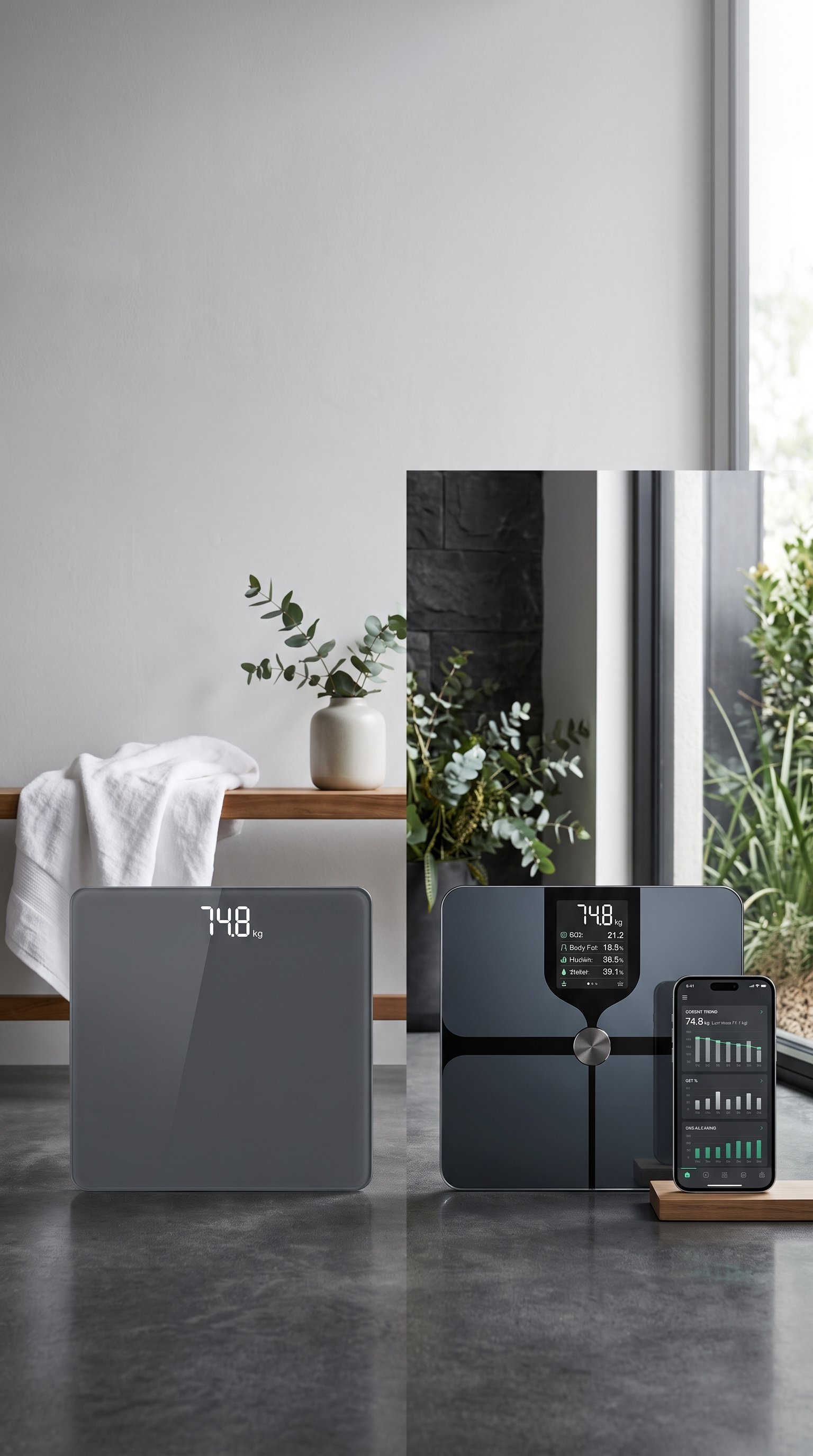
| Feature | Smart Scale | Normal Digital Scale |
|---|---|---|
| Weight measurement | Direct measurement, generally accurate | Direct measurement, generally accurate |
| Body-composition estimates | Yes, via BIA (estimates, not exact measurements) | Usually not available |
| App / history tracking | Automatic logging and trend charts | Manual logging only, if any |
| Multi-user profiles | Supported, often with auto-recognition | Not applicable |
| Connectivity | Bluetooth and/or Wi-Fi | None |
| Typical price range (research context) | Roughly A$30–A$210 across this guide's five models | Generally lower |
| Battery needs | Yes — AAA batteries or rechargeable, varies by model | Usually minimal, simple batteries or none |
| Best for | Trend tracking, app integration, multi-user households | Buyers who only want a simple, reliable weight reading |
Do You Need a Smart Scale?
A smart scale is likely worth it if you want your weigh-ins logged automatically over time, you're interested in tracking general body-composition trends alongside weight, or you want that data to feed into an app or fitness ecosystem you already use. It can also help a household keep everyone's readings organised without manual logging.
A simple digital bathroom scale may serve you just as well if you only care about your weight, don't want to manage an app or Bluetooth/Wi-Fi connectivity, or you're not particularly interested in body-composition trend data. There's no requirement to buy a smart scale — it's a convenience and data-tracking upgrade over a basic scale, not a necessity.
Understand Your Numbers
A smart scale can collect and estimate a range of measurements, but understanding what those numbers mean for you personally is a separate step. MegaCalcOnline's free calculators can help you make sense of related health metrics using your own details — they don't diagnose any health condition, and they're not a substitute for advice from a healthcare professional, but they can add useful context alongside the trend data your scale collects.
Weight Trend Calculator
A simple numerical comparison of two weigh-ins over time. This describes the change only and does not provide medical advice or say whether a change is healthy for you.
This calculator describes the numerical change only and does not provide medical advice.
Final Verdict
There isn't one smart scale in this group that suits every buyer — the right choice depends on your budget, whether you want segmental body-composition data, and which app ecosystem you already use. If you're on a tight budget and want straightforward weight and body-composition trend tracking, the RENPHO Elis 1 offers strong value with a large, established review history. If you want the longest feature list for a modest price increase, the Xiaomi S400 is worth considering — provided you verify Australian Mi Home app compatibility first. For segmental body-composition tracking across arms, legs and trunk, the RENPHO MorphoScan Base is the only option in this guide built for that. If you want the broadest everyday feature set and Wi-Fi convenience and are comfortable with mixed long-term reliability feedback, the Withings Body Smart fits that brief. And if you're already using Garmin Connect for training, the Garmin Index S2 makes the most sense — not because it's inherently more accurate, but because your weigh-ins will sync straight into data you're already using.
Frequently Asked Questions
Are smart scales accurate?
Smart scales are generally accurate for the one thing they measure directly — weight — provided they're placed on a hard, flat surface and calibrated correctly. Other readings such as body-fat percentage, muscle mass and visceral fat are estimates calculated from bioelectrical impedance analysis (BIA) combined with your age, height and sex, so they should be treated as approximations rather than precise clinical measurements.
Are smart scales accurate for body fat?
Body-fat estimates from consumer smart scales can vary depending on hydration, recent meals, exercise, time of day and even foot placement on the electrodes. They're most useful for tracking a general trend over weeks or months under fairly consistent conditions, rather than relying on any single reading as an exact figure.
What is the best smart scale in Australia?
There's no single "best" smart scale for everyone — it depends on your budget, whether you want basic weight and BMI tracking or detailed segmental body-composition data, and which app ecosystem you already use. This guide compares five options across those different needs, from the budget-friendly RENPHO Elis 1 to the Garmin-ecosystem-focused Garmin Index S2.
Is a smart scale worth buying?
A smart scale is worth considering if you want to track weight and general body-composition trends over time without manually logging numbers, especially if the app syncs with a fitness platform you already use. If you only want a simple, accurate weight reading, a basic digital bathroom scale may be all you need — see our comparison above.
How do smart scales measure body fat?
Most consumer smart scales use bioelectrical impedance analysis (BIA): a very small, imperceptible electrical current passes through your body via metal electrodes on the platform (or a handle, on eight-electrode models), and the device estimates body composition based on how quickly that current travels, combined with your entered age, height and sex.
Is Wi-Fi better than Bluetooth for a smart scale?
Wi-Fi scales can sync your data automatically in the background without needing your phone nearby, which can be convenient for multi-user households. Bluetooth-only scales generally need your phone's Bluetooth on and the app open or recently used nearby to sync, but they typically use less power and can have longer battery life as a result.
Can multiple people use the same smart scale?
Yes — most smart scales in this guide support multiple user profiles, from around 8–16 on-device profiles up to unlimited app profiles depending on the model, and several can automatically recognise who has stepped on based on stored body data. Check the specific model's listed profile limit if you have a larger household.
Should I weigh myself at the same time each day?
Weighing yourself at a consistent time — many people choose first thing in the morning, before eating or drinking — helps reduce the natural day-to-day fluctuations caused by food, fluid and activity, making any trend you see more meaningful. This applies to both weight and body-composition readings.
Are eight-electrode smart scales better?
Eight-electrode scales typically add a handle with electrodes for your hands alongside the platform electrodes for your feet, and are designed to estimate body composition segmentally — arms, legs and trunk separately — rather than as a single whole-body figure. This can offer more detailed tracking data, but it doesn't necessarily mean the underlying body-fat percentage estimate itself is clinically more accurate — it's still BIA-based.
Can smart scales replace professional body-composition testing?
No. Methods such as DEXA scans, hydrostatic weighing or clinical BIA devices used by healthcare professionals are generally considered more precise than consumer smart scales. A home smart scale is better suited to convenient day-to-day trend tracking than to replacing a professional assessment.